
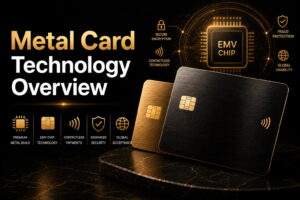
What Technology Is Involved in a Metal Card?
A metal card combines several distinct technologies: the EMV chip that handles payment transactions, laser engraving technology that creates permanent personalization, and — in some cases — an NFC antenna that enables contactless payment. Each technology operates independently, meaning the metal body itself doesn’t power or enhance any of them.
Understanding how these systems work separately is the clearest way to evaluate what a metal card actually offers from a technical standpoint, rather than relying on assumptions about the material.
EMV Chip Technology
The EMV chip is the core payment technology in any modern card, metal or plastic.
What the chip does:
- Generates a unique cryptographic code for each transaction
- Authenticates the card and cardholder during a purchase
- Prevents the reuse of stolen transaction data, unlike older magnetic stripe systems
How this applies to metal cards:
When a plastic card is converted into metal, the chip is not replaced or reprogrammed — it’s physically relocated. The chip’s encryption and transaction logic remain exactly the same as they were in the original card. A full explanation of this process is available at How Metal Cards Work.
Laser Engraving Technology
Laser engraving is the manufacturing technology responsible for metal card personalization, and it works fundamentally differently from plastic card printing.
How it works technically:
- A precision laser removes microscopic layers of the metal surface
- The depth and angle of the laser create contrast between the engraved area and the surrounding surface
- Different metals and finishes respond differently to laser calibration, affecting contrast and clarity
Why this matters:
- Because the design is physically etched rather than printed, it doesn’t wear off with handling
- Engraving allows fine detail — text, logos, and patterns — with consistent precision
- Laser settings can be adjusted for different finishes, which is why brushed, matte, and mirror surfaces produce different engraving contrast
This technology is what separates permanent metal personalization from standard printed plastic. A deeper look at the process is available in Laser Engraving Explained.
NFC and Contactless Technology
NFC (Near Field Communication) is the technology behind tap-to-pay, and it’s the most misunderstood piece of metal card technology.
Key technical facts:
- NFC requires a small embedded antenna, separate from the EMV chip
- This antenna must be specifically integrated during manufacturing or conversion
- A standard metal card conversion, which transfers an existing chip, does not automatically include this antenna
Why this matters for conversions:
If contactless payment is a priority, it needs to be confirmed as part of the conversion process, since it isn’t a default feature of transferring a chip into a metal body. This is covered in more detail in the Card Compatibility Guide.
Magnetic Stripe Technology (Where Applicable)
Some cards still include a magnetic stripe alongside the chip, primarily as a fallback for terminals that don’t support chip reading.
Technical notes:
- The stripe stores static data, which is why it’s considered less secure than chip technology
- If present on the original card, the stripe can be preserved during conversion depending on the card’s design
- Not all metal card conversions retain a functional magnetic stripe, depending on the layout and provider process
Manufacturing Technology Behind Metal Cards
Producing a metal card involves more than adding metal to a standard card mold. Several manufacturing technologies are involved.
Key production technologies:
| Technology | Purpose |
|---|---|
| CNC cutting | Shapes metal blanks to precise card dimensions |
| Laser engraving systems | Applies permanent personalization and designs |
| Surface finishing equipment | Creates brushed, matte, or mirror finishes |
| Chip embedding tools | Secures the transferred EMV chip into the metal body |
| Anodizing equipment (aluminum only) | Applies color finishes without paint or ink |
Each stage requires different equipment and precision levels, which is part of why metal card production takes longer and costs more than standard plastic card manufacturing. This is explained further in Metal Card Materials.
How These Technologies Work Independently
A useful way to understand metal card technology is to separate it into two categories:
Function-related technology:
- EMV chip
- NFC antenna (if present)
- Magnetic stripe (if present)
Form-related technology:
- Laser engraving systems
- Surface finishing processes
- Metal cutting and shaping equipment
Function-related technology determines how a card performs at checkout. Form-related technology determines how the card looks, feels, and holds up physically. Neither category depends on the other, which is why a card can have advanced engraving with only basic chip functionality, or vice versa.
A broader breakdown of how these systems combine is available in Metal Card Features Explained.
Common Technology-Related Questions During Conversion
Since conversion involves transferring existing technology into a new body, a few technical points are worth confirming beforehand:
- Chip condition — whether the original chip is functioning correctly before transfer
- NFC presence — whether the original card has contactless capability, and whether it can be preserved
- Magnetic stripe retention — whether the stripe will remain functional post-conversion
- Card thickness compatibility — whether the original card’s chip placement fits standard metal card specifications
These checks are part of a standard compatibility assessment, outlined in the Card Compatibility Guide.
Technology Comparison: Metal Card vs. Standard Plastic Card
| Technology | Metal Card | Plastic Card |
|---|---|---|
| EMV chip | Same as original (transferred) | Standard |
| NFC/contactless | Only if specifically integrated | Common on modern cards |
| Magnetic stripe | Preserved if present and compatible | Standard |
| Personalization method | Laser engraving | Printing/embossing |
| Manufacturing process | CNC cutting, laser engraving, finishing | Injection molding, printing |
Frequently Asked Questions
What technology makes a metal card work the same as a plastic one?
The EMV chip. It’s the component responsible for processing transactions, and it functions identically regardless of the material surrounding it.
Does laser engraving use the same technology as plastic card printing?
No. Laser engraving physically removes material to create a design, while plastic cards use surface printing. This is why engraving doesn’t fade the way printed text can.
Can NFC technology be added to any metal card during conversion?
Not always. Adding or preserving NFC functionality depends on the original card’s design and whether an antenna can be properly integrated during the conversion process.
Is the chip in a converted metal card different from the one in the original plastic card?
No. The same physical chip is transferred from the plastic card into the metal card — it isn’t replaced, reprogrammed, or upgraded.
Why does metal card manufacturing take longer than plastic card production?
Metal cards require multiple precision technologies — cutting, engraving, finishing, and chip integration — each performed as a separate manufacturing step, unlike the faster molding and printing process used for plastic.
Conclusion
Metal card technology is best understood as a set of independent systems working together rather than a single upgraded feature. The EMV chip handles function, laser engraving handles personalization, and manufacturing technology shapes the card’s physical form. None of these systems depend on each other, which is why a metal card can offer permanent, precise engraving while still functioning exactly like the plastic card it came from.
Knowing which technology controls which outcome makes it much easier to set accurate expectations — particularly around contactless payment and security — before choosing a metal card or conversion service.