
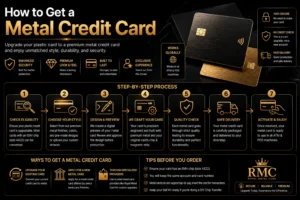
How to Get a Metal Credit Card
There is something undeniably satisfying about pulling a solid, heavy metal credit card out of your wallet. The weight. The finish. The sound it makes when it hits a counter. It is the kind of card that makes people look twice — and for good reason.
Metal credit cards have evolved from ultra-exclusive banking perks available only to millionaires into something far more accessible in 2026. Today, millions of Americans carry metal credit cards — and there are now more ways than ever to get one, whether through a bank application, an upgrade request, or a custom metal card conversion service that does not require switching banks at all.
But here is the thing most guides will not tell you: you do not necessarily need perfect credit, a high income, or a willingness to pay $695 a year just to carry a metal credit card. There is a smarter path — and this guide covers every single one of them.
By the end of this article, you will know exactly how to get a metal credit card in 2026, which route makes the most sense for your situation, what requirements you need to meet, and how to get a fully customized metal card without the annual fees, the application process, or the bank restrictions.
Quick Answer: How Do You Get a Metal Credit Card?
There are two main ways to get a metal credit card in 2026. The first is to apply for a bank-issued metal credit card — which typically requires a credit score of 700 or higher and often comes with annual fees ranging from $0 to $695. The second — and easier — option is to use a custom metal card conversion service like Royal Metal Card, which transfers your existing credit card’s EMV chip into a premium custom-designed metal card body, keeping your same bank account and card details without any application or annual fees.
What Is a Metal Credit Card?
A metal credit card is a payment card made from premium metallic materials — most commonly stainless steel, titanium, or aluminum — rather than standard PVC plastic. Metal credit cards function identically to plastic credit cards at ATMs, Point-of-Sale (POS) terminals, and online checkout pages. The difference is entirely in the physical construction, weight, feel, and durability.
Metal credit cards were first popularized in the early 2000s by the American Express Centurion Card — better known as the “Amex Black Card” — which was invite-only and required an enormous minimum annual spend. Since then, metal credit cards have become increasingly mainstream, with major issuers including Chase, Capital One, Citi, Apple, and many others now offering metal card options across a wider range of income levels and credit profiles.
In 2026, you can get a metal credit card at virtually every credit tier from good to excellent — and through conversion services, you can get one at any credit level without applying for anything new at all.
The Two Main Ways to Get a Metal Credit Card
Route 1: Apply for a Bank-Issued Metal Credit Card
The traditional route to a metal credit card is applying directly through a bank or card issuer. This path gives you access to premium rewards programs, travel benefits, airport lounge access, and other perks — but it comes with credit requirements, income considerations, and often significant annual fees.
Route 2: Convert Your Existing Card to Metal
The modern, accessible alternative is using a custom metal card conversion service. Instead of applying for a new card, you keep your existing credit card account and simply upgrade the physical card body from plastic to premium metal — with a fully custom design of your choice.
This route requires no credit check, no bank approval, no annual fee, and no switching accounts. It is the fastest and most flexible way to carry a metal credit card in 2026.
Both routes are covered in complete detail below.
Route 1: How to Get a Bank-Issued Metal Credit Card
Step 1: Check Your Credit Score
The most important qualification for a bank-issued metal credit card is your credit score. Here is what you need to know:
- Good credit (700–749 FICO) — Qualifies for most mainstream metal credit cards including the Chase Sapphire Preferred, Capital One Venture X, and many others
- Excellent credit (750+ FICO) — Opens access to premium metal cards including the American Express Platinum, Chase Sapphire Reserve, and other top-tier products
- Exceptional / Invite-only (800+) — Required for ultra-exclusive metal cards like the American Express Centurion Card (Amex Black Card)
You can check your credit score for free through:
- Your bank’s mobile app (most major banks now offer free FICO score access)
- Credit card issuer dashboards (Chase, Discover, Capital One all offer free scores)
- AnnualCreditReport.com for your full credit report
If your credit score is below 700, you may still be able to get a metal card through a no-annual-fee option or a secured card upgrade path — but your options will be more limited among bank-issued products.
Step 2: Choose the Right Metal Credit Card for Your Needs
Not all metal credit cards are the same. The right card depends on your spending habits, lifestyle, and what benefits matter most to you. Here is a breakdown of the major categories:
Premium Travel Metal Credit Cards
These cards target frequent travelers with high annual fees offset by luxury travel benefits:
American Express Platinum Card
- Annual fee: $695
- Material: Stainless steel (18.5 grams — one of the heaviest metal cards available)
- Key benefits: 5X points on flights and hotels booked through Amex Travel, access to over 1,550 airport lounges globally through the Global Lounge Collection including Centurion Lounges, over $850 in annual statement credits, TSA PreCheck/Global Entry credit, Hilton and Marriott elite status
- Credit required: Good to Excellent (700+)
- Best for: Frequent travelers who spend heavily on flights and hotels and will use the premium travel benefits to offset the annual fee
Chase Sapphire Reserve
- Annual fee: $550
- Material: Metal (notably heavy — titanium blend)
- Key benefits: 8X points through Chase Travel, 4X on flights and hotels booked direct, $300 annual travel credit, Priority Pass airport lounge access, primary rental car insurance, comprehensive travel protections, $3,000+ in estimated annual value
- Credit required: Good to Excellent (700+)
- Best for: Frequent travelers who prefer Chase’s Ultimate Rewards ecosystem and want strong travel protections alongside premium rewards
Mastercard Black Card
- Annual fee: Varies
- Material: Carbon with metal finish
- Key benefits: 2% redemption value for airfare, 1.5% for all other redemptions, airport lounge access, luxury travel perks
- Credit required: Excellent (750+)
- Best for: Travelers who prioritize airfare redemption value and luxury travel experiences
Mid-Range Metal Credit Cards
These cards offer metal construction with more moderate annual fees and broader accessibility:
Chase Sapphire Preferred
- Annual fee: $95
- Material: Metal
- Key benefits: 5X on travel booked through Chase Travel, 3X on dining, 100,000 bonus points welcome offer (after $5,000 spend in first 3 months), comprehensive travel insurance, no foreign transaction fees
- Credit required: Good to Excellent (700+)
- Best for: Travelers who want premium card quality and strong rewards without a high annual fee
Capital One Venture X
- Annual fee: $395
- Material: Metal
- Key benefits: 10X miles on hotels and rental cars through Capital One Travel, 5X on flights, $300 annual travel credit, Capital One lounge access, Priority Pass membership, 75,000 mile welcome bonus
- Credit required: Excellent (750+)
- Best for: Travelers who want a mid-range premium card with strong lounge access and straightforward mile earning
No Annual Fee Metal Credit Cards
Yes — metal credit cards with no annual fee do exist in 2026:
Apple Card
- Annual fee: $0
- Material: Titanium
- Key benefits: 3% cash back at Apple and select merchants via Apple Pay, 2% back on all Apple Pay purchases, 1% when using the physical card, no fees of any kind
- Credit required: Good (700+)
- Best for: Apple ecosystem users who want a premium titanium card with no annual fee
US Bank Altitude Go Visa Signature
- Annual fee: $0
- Material: Metal
- Key benefits: 4X points on dining, 2X on groceries and streaming, no annual fee
- Credit required: Good (700+)
- Best for: Dining enthusiasts who want a metal card with no annual cost
Step 3: Apply for the Card
Once you have identified the right metal credit card for your needs:
- Visit the card issuer’s official website — Never apply through third-party sites for premium cards; always go directly to the bank’s secure application portal
- Complete the application — You will need to provide personal information including your full name, address, Social Security Number (SSN), date of birth, employment status, and annual income
- Submit and wait for a decision — Many card issuers provide instant approval decisions. Some premium cards may take 7 to 10 business days for a decision.
- Activate your card — Once approved, your metal card will arrive by mail in a premium package. Follow the activation instructions provided.
Step 4: Understand What You Are Getting
Before applying, be honest with yourself about a few key factors:
Will you actually use the benefits? A $695 annual fee card is only worth it if you use enough of the benefits to exceed that cost. Airport lounge access, travel credits, and premium insurance have real value — but only if you travel frequently enough to use them.
Can you meet the minimum spend for the welcome bonus? Most premium metal cards require spending $5,000 to $12,000 within the first 3 to 6 months to earn the welcome bonus. Make sure this aligns with your normal spending rather than forcing unnecessary purchases.
Are you comfortable with the hard credit inquiry? Every new credit card application results in a hard inquiry on your credit report, which can temporarily lower your credit score by a few points.
Route 2: How to Get a Custom Metal Credit Card Through Conversion
This is the route most guides ignore — but it is the most accessible, most affordable, and most customizable way to carry a metal credit card in 2026.
What Is Metal Card Conversion?
Metal card conversion is the process of transferring the EMV chip from your existing plastic credit card into a brand new premium metal card body. The result is a fully working metal credit card that is linked to your exact same bank account — with the same card number, same PIN, same credit limit, same rewards program, and same everything.
Nothing changes about your banking relationship. Only the physical card material changes — from plastic to premium metal.
Who Is This Route For?
Custom metal card conversion through Royal Metal Card is perfect for:
- Anyone who loves their current bank or credit card but hates the plastic card body
- Anyone who does not want to apply for a new credit account or face another credit inquiry
- Anyone who wants a fully customized metal card design rather than a boring bank-approved look
- Anyone who wants to avoid annual fees of $95 to $695 per year
- Anyone whose credit score may not qualify for premium bank metal cards
- Business owners who want their company logo on their metal credit card
- Collectors, anime fans, car enthusiasts, and anyone who wants a card that reflects their personality
How the Conversion Process Works
Getting a custom metal credit card through Royal Metal Card is a simple five-step process:
Step 1: Choose Your Design Browse the design library or submit your own custom artwork. Options include:
- Minimalist luxury designs in gold, silver, and black
- Anime and pop culture themed cards
- Automotive and car brand inspired designs
- Business branding with company logo and name
- Religious and spiritual artwork
- Fully custom — upload any image you own the rights to
- Personal name engraving with permanent laser etching
Step 2: Place Your Order Select your preferred metal material — aluminum, stainless steel, or titanium — and complete your order. No credit check. No application. No bank approval required.
Step 3: Receive Your Kit Your custom metal card arrives with a complete DIY installation kit including all tools and step-by-step instructions needed to transfer the EMV chip yourself at home. The entire process takes 2 to 5 minutes.
Step 4: Transfer the Chip Using the included precision tools, carefully remove the EMV chip from your existing plastic credit card and install it into the new metal card body. The chip transfer is simple, safe, and does not expose or alter any of your banking data.
Step 5: Test and Use Test your new metal credit card at an ATM and a Point-of-Sale terminal to confirm everything is working perfectly. Your metal card is now ready for daily use — with the same account, same rewards, and same benefits as before.
Cost Comparison: Conversion vs Bank Metal Cards
| Factor | Custom Conversion (Royal Metal Card) | Bank Metal Credit Cards |
|---|---|---|
| Upfront cost | $50–$200 one-time | $0 application fee |
| Annual fee | $0 — none ever | $0 to $695 per year |
| 5-year total cost | $50–$200 total | $0 to $3,475 total |
| Credit check required | ❌ No | ✅ Yes — hard inquiry |
| Bank switching required | ❌ No | ✅ New account required |
| Custom design | ✅ Unlimited | ❌ Fixed bank design |
| Existing rewards preserved | ✅ Yes | ❌ New rewards program |
| Approval required | ❌ None | ✅ Bank approval needed |
| Available to everyone | ✅ Yes | ❌ Credit requirements apply |
The math is straightforward. Over five years, a $695 annual fee metal card costs up to $3,475. A custom metal card conversion costs $50 to $200 — once — and delivers greater design freedom with zero ongoing cost.
Who Qualifies for a Metal Credit Card?
For Bank-Issued Metal Cards
Qualification requirements vary by card tier:
Standard metal cards (Chase Sapphire Preferred, Apple Card, US Bank Altitude Go)
- Minimum credit score: 700 (Good credit)
- Income: Stable income required; specific minimums vary by issuer
- Credit history: At least 1-2 years of credit history preferred
- No recent derogatory marks preferred
Premium metal cards (Amex Platinum, Chase Sapphire Reserve, Capital One Venture X)
- Minimum credit score: 720–750 (Good to Excellent)
- Income: Higher income generally required; no publicly stated minimum but issuers consider income-to-debt ratio
- Credit history: 3+ years of positive credit history preferred
- Low credit utilization preferred (under 30%)
Ultra-premium / invite-only (Amex Centurion Black Card)
- Minimum credit score: 800+ (Exceptional)
- Income: Very high income required
- Existing Amex relationship: Must be an existing Amex cardholder with very high annual spend (reportedly $500,000+)
- Invitation required: Cannot apply — must be invited by American Express
For Custom Metal Card Conversion
There are no credit requirements for metal card conversion. If you already have a Visa or Mastercard credit card with an EMV chip, you qualify — regardless of your credit score, income, or banking history.
Metal Credit Card Materials: What Are They Actually Made From?
Understanding what your metal credit card is actually made from helps you choose the right option for your needs.
Stainless Steel
The most common material in premium bank metal cards and conversion cards. Stainless steel is:
- Extremely durable — resists bending, scratching, and wear
- Satisfyingly heavy — typically 14 to 22 grams versus 5 grams for plastic
- Premium in appearance — the brushed or polished finish looks genuinely luxurious
- Excellent for laser engraving — designs are crisp, permanent, and highly detailed
Examples: Chase Sapphire Reserve, American Express Platinum (stainless steel body with metal alloy)
Titanium
The premium tier of metal card materials. Titanium is:
- Stronger than steel at lower weight — incredible strength-to-weight ratio
- Highly corrosion resistant — the same material used in aerospace and medical applications
- Ultra-premium feel — the feel that defines “top tier” luxury cards
- Best for permanent engraving — laser engraving on titanium is exceptionally sharp and permanent
Examples: Apple Card (pure titanium), certain Royal Metal Card premium conversion options
Aluminum
The lightweight alternative that still delivers premium quality:
- Much lighter than steel — ideal for slim wallet users and those sensitive to weight
- More affordable — typically the most cost-accessible metal card material
- Excellent design reproduction — holds color and engraving very well
- Still far more durable than plastic — outlasts PVC cards significantly
Benefits of Metal Credit Cards
Whether you get a bank-issued metal card or a custom conversion, the benefits of metal credit cards over plastic are real and significant.
Superior Durability and Lifespan
Standard plastic credit cards last 1 to 3 years before showing visible wear — bending, scratching, fading, and cracking. Metal credit cards last 5 to 10 years or more with daily use. The laser-engraved design on a metal card will look identical in year eight as it did on day one.
Premium Look and Feel
Metal cards make an impression that plastic never can. The weight, the finish, the sound when it touches a counter — every sensory detail communicates quality. In professional settings, first impressions from a metal card are measurably different from those made by a standard plastic card.
Status and Exclusivity
Metal credit cards carry genuine social status. Whether it is a bank-issued premium card or a custom conversion, a metal card signals that you have invested in quality — and people notice.
Permanent Laser Engraving
Unlike printed plastic card designs that fade and peel, laser-engraved metal card designs are physically part of the metal surface. They cannot wash off, chip, or fade over any amount of time or use.
Works Everywhere Plastic Does
Metal credit cards work at every ATM, POS terminal, restaurant, retail store, online checkout, and international payment system that accepts your card network (Visa or Mastercard). From the payment system’s perspective, a metal card and a plastic card are identical — only the physical body is different.
Common Questions About Getting a Metal Credit Card
Can I Request a Metal Card From My Existing Bank?
Sometimes. If your bank has switched from plastic to metal cards for your card type since you originally received your card, you may be able to request a metal replacement by calling customer service. However, most banks do not allow you to choose between plastic and metal for the same card product — the card material is determined by the product, not the customer’s preference.
If your existing bank does not offer a metal version of your card, your options are: apply for a new metal card from that bank or another issuer, or use a custom conversion service to upgrade your existing card to metal.
Do Metal Cards Affect Your Credit Score?
The metal material of a card has no effect on your credit score whatsoever. If you are applying for a new bank-issued metal card, the hard inquiry from the application may temporarily reduce your score by a few points. The conversion route has zero impact on your credit score since no new account is opened.
Can I Get a Metal Credit Card With Bad Credit?
For bank-issued metal cards, bad credit (below 670) typically disqualifies you from most options. However, through custom metal card conversion, you can get a metal credit card at any credit level — the conversion service does not check your credit at all. As long as you have an existing credit card with an EMV chip, you can convert it to metal.
How Long Does It Take to Get a Metal Credit Card?
For bank-issued metal cards: application decisions are often instant, but the physical card delivery typically takes 7 to 14 business days after approval.
For custom conversion through Royal Metal Card: production and shipping typically takes 1 to 3 weeks. Once the card arrives, the DIY chip installation takes 2 to 5 minutes.
Do Metal Cards Work With Apple Pay and Google Pay?
Yes. Your digital wallet connections (Apple Pay, Google Pay, Samsung Pay) are linked to your bank account, not the physical card. After either getting a new metal card or converting your existing card to metal, your digital wallet continues to work exactly as before.
Is There a Metal Debit Card Option?
Absolutely. The same conversion process available for credit cards is fully available for debit cards. If you prefer a metal debit card that draws directly from your checking account — with no credit involved — Royal Metal Card’s conversion service handles Visa and Mastercard debit cards with exactly the same process and results.
How to Choose Between Bank Metal Cards and Custom Conversion
Use this decision guide to determine which route is right for you:
Choose a bank-issued metal credit card if:
- You want access to premium travel rewards, airport lounges, and luxury card benefits
- You are a frequent traveler who will use the benefits to justify annual fees
- You have good to excellent credit (700+) and are comfortable with a new credit inquiry
- You do not have an existing card you love and are open to switching
Choose custom metal card conversion through Royal Metal Card if:
- You love your current bank account and do not want to switch
- You want a fully customized design — not a generic bank logo
- You want to avoid annual fees of $95 to $695 per year
- Your credit score may not qualify for premium bank cards
- You are a business owner who wants your company branding on your card
- You want the fastest and most affordable path to a premium metal card
- You are an anime fan, car enthusiast, collector, or anyone who wants a card that truly reflects your identity
Frequently Asked Questions (FAQ)
How do I get a metal credit card? You can get a metal credit card by applying for a bank-issued metal card (requires good to excellent credit and often involves annual fees), or by using a custom metal card conversion service that transfers your existing credit card’s chip into a new premium metal card body — no application or annual fee required.
What credit score do I need for a metal credit card? Most bank-issued metal credit cards require a minimum credit score of 700 (good credit). Premium cards like the Amex Platinum and Chase Sapphire Reserve typically require 720 to 750 or higher. Through custom conversion, no credit score requirement applies.
Can I get a metal credit card without paying annual fees? Yes — two ways. The Apple Card and US Bank Altitude Go are bank-issued metal cards with no annual fee. Alternatively, custom metal card conversion is a one-time purchase with no ongoing annual fees.
How much does a metal credit card cost? Bank-issued metal cards range from $0 (Apple Card) to $695 per year (Amex Platinum). Custom metal card conversion through Royal Metal Card is a one-time cost of $50 to $200 with no recurring fees.
Can I convert my existing credit card to metal? Yes. Royal Metal Card’s conversion service transfers your existing Visa or Mastercard credit card’s EMV chip into a custom-designed premium metal card body. Your card number, PIN, account, and rewards all stay the same.
Do metal credit cards work internationally? Yes. Metal credit cards work at international ATMs and POS terminals in every country where your card network (Visa or Mastercard) is accepted — identical to your original plastic card.
Can I customize a metal credit card? Through bank-issued cards — very limited or no customization. Through custom conversion services like Royal Metal Card — unlimited customization including custom artwork, business logos, anime designs, laser engraving, and more.
Is a metal credit card worth it? Yes, for most people. The durability, premium experience, and status appeal of a metal credit card deliver real value. Custom conversion makes this experience affordable for everyone — not just those who can afford $695 annual fees.
What metal are most credit cards made of? Most bank-issued metal credit cards use stainless steel. The Apple Card uses titanium. Some premium conversion options offer aluminum, stainless steel, or titanium depending on the buyer’s preference.
Will getting a metal card hurt my credit score? If you apply for a new bank-issued metal card, there will be a hard inquiry that may temporarily lower your score a few points. Custom metal card conversion has zero impact on your credit score since no new account is opened.
Can a debit card be converted to a metal card? Yes. Royal Metal Card’s conversion service works with both Visa and Mastercard debit and credit cards. The process is identical for both card types.
How long do metal credit cards last? Bank-issued metal cards typically last until expiry (3 to 4 years) though the physical card itself could last much longer. Custom metal conversion cards made from stainless steel or titanium can last 5 to 10 years or more with daily use.
Final Thoughts: The Smartest Way to Get a Metal Credit Card in 2026
Getting a metal credit card in 2026 is easier than ever — but the right path depends entirely on what you are looking for.
If premium travel rewards, airport lounge access, and luxury card perks are your priority — and you have the credit score and spending habits to justify the annual fees — a bank-issued premium metal credit card delivers real value. The Chase Sapphire Reserve, Amex Platinum, and Capital One Venture X are all excellent products for the right user.
But if what you really want is the premium metal card experience — the weight, the feel, the custom design, the status — without the annual fees, the credit requirements, and the bank restrictions, then custom metal card conversion is the smarter choice.
One-time cost. No annual fees. No credit check. No switching banks. Fully customized design. Your same account, your same rewards, your same everything — just in a premium metal card that looks and feels exactly the way you want it to.
That is exactly what Royal Metal Card delivers.
Ready to upgrade? Visit royalmetalcard.com to explore custom metal credit card designs and find the perfect card that represents who you are without the annual fees, without the bank restrictions, and without the compromise.