
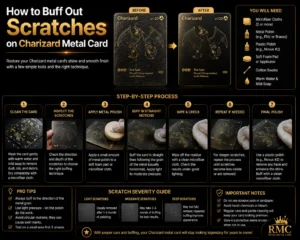
How to Buff Out Scratches on Charizard Metal Card
You finally have it. The gold Charizard metal card from the Pokémon Celebrations Ultra Premium Collection — one of the most iconic collectible cards ever produced. A stunning gold metal reprint of the original 1999 Base Set Charizard 4/102, released in honor of the 25th anniversary of the Pokémon franchise.
And then you look closely — and there it is. A scratch. Maybe a small surface scuff from handling. Maybe a deeper mark from sliding against something in the box. Maybe the notorious shipping damage that affected countless Celebrations Charizard metal cards right out of the package. Either way, your heart sinks a little.
The good news is that scratches on a metal Charizard card are not necessarily permanent. Depending on the depth and location of the scratch, there are several safe methods to reduce or fully remove the damage — restoring your card’s appearance and protecting its collector value.
The key word is safely. This is not a standard plastic card. The Celebrations Charizard metal card is a limited edition collectible worth anywhere from $70 to $475 or more depending on condition and grade. Every technique you use must be approached with care, patience, and the right tools — because the wrong approach can turn a minor scratch into an irreparable error.
This complete guide covers everything you need to know about how to buff out scratches on your Charizard metal card — from understanding what the card is made of, to identifying scratch types, to step-by-step restoration methods, to knowing when to leave it alone.
Quick Answer: Can You Buff Out Scratches on a Charizard Metal Card?
Yes — light surface scratches on the Charizard metal card can often be reduced or removed using a polishing compound like Polywatch, applied gently with a microfiber cloth in the direction of the card’s grain or finish. Deep gouges cannot be fully restored at home. Always test any method on an inconspicuous area first, and consider whether restoration is appropriate if you plan to submit the card for PSA or BGS grading — as altered cards may be flagged.
Understanding the Charizard Metal Card
Before attempting any restoration, it is essential to understand exactly what this card is — because its materials, construction, and collector status all affect how you should approach scratch removal.
What Is the Charizard Metal Card?
The Charizard metal card (card number 4/102) is a special promotional card released exclusively in the Pokémon TCG Celebrations Ultra Premium Collection in October 2021. It is a metal reprint of the original Base Set Charizard — widely considered the most iconic Pokémon card ever printed.
Key facts about the card:
- Set: Pokémon TCG Celebrations — 25th Anniversary
- Card number: 4/102
- Rarity: Promo (exclusive to the Ultra Premium Collection)
- Finish: Gold holo metallic finish
- Material: Metal construction — not standard cardboard or PVC plastic
- Illustrator: Mitsuhiro Arita (original Base Set artist)
- HP: 120
- Current market value: Raw near-mint copies typically sell for $70–$150; PSA 9 graded copies have sold for $475+
- Availability: Limited — only available through the Celebrations Ultra Premium Collection; no standalone reprints confirmed
The card is made from metal with a gold-colored holo finish on the front surface. This finish is what gives the card its iconic appearance — and it is also what makes scratch removal a delicate operation.
Why Do Charizard Metal Cards Get Scratched?
The Celebrations Charizard metal card has a well-documented issue with scratch damage. Many collectors received cards with pre-existing scratches or chips directly from sealed Celebrations Ultra Premium Collection boxes — a result of the card moving around inside the packaging during shipping and handling.
Common causes of scratches on the Charizard metal card include:
- Factory and shipping damage — The card sliding against the acrylic display case insert during transit
- PSA slab movement — Some graded copies have been reported to scratch inside the PSA slab due to the card not being held completely immobile
- Handling without sleeves — Fingerprints and contact with hard surfaces create surface marks
- Wallet or deck storage — Direct contact with other cards or hard objects
- Display without protection — Displayed without a protective case or sleeve
Understanding the cause of your scratch helps you choose the right restoration approach.
What Is the Gold Finish Made From?
The gold metallic holo finish on the front of the Charizard metal card is a surface coating applied over the metal body of the card. This is not solid gold — it is a metallic finish layer that gives the card its distinctive appearance.
This distinction matters enormously for scratch removal:
- Surface scratches — Affect only the top finish layer. These are the most treatable and can often be polished or buffed to significantly reduce their visibility.
- Deep scratches / gouges — Penetrate through the finish layer into the metal body beneath. These are very difficult or impossible to fully restore at home without specialized equipment.
- Edge chips — Damage to the physical edge of the metal card. These are structural rather than cosmetic and cannot be buffed out.
Step 1: Assess the Scratch Before Doing Anything
The most important step in the entire process happens before you touch the card with any product or tool.
The Fingernail Test
Run your clean fingernail very lightly across the scratch. This simple test tells you a lot:
- If your fingernail does not catch — The scratch is a surface-level mark, likely in the finish coating only. These are the most treatable scratches and have the best chance of significant improvement with gentle polishing.
- If your fingernail catches slightly — The scratch has some depth into the finish but may still be partially improvable with the right polishing compound.
- If your fingernail catches clearly — The scratch is deep, reaching into or through the finish layer. Home restoration may reduce its visibility but is unlikely to fully remove it. Professional evaluation may be warranted.
Examine Under Good Lighting
Before any treatment, examine the card under good, angled lighting — a lamp or flashlight held at an angle to the card surface works well. This allows you to see the full extent of the scratch and identify any additional marks you might have missed.
Take a photograph of the card in this lighting before you start. This gives you a clear before reference to compare against after treatment.
Consider the Card’s Intended Use
Ask yourself honestly: what am I going to do with this card?
- If you plan to submit it for PSA or BGS grading — Read the important note at the end of this guide before proceeding. Grading companies can detect altered cards, and restoration may affect the grade or result in the card being flagged.
- If you plan to keep it as a personal display piece — Restoration to improve its visual appearance is a perfectly reasonable choice.
- If you plan to sell it — You must disclose any restoration work to buyers. Selling a restored card as unrestored is unethical and potentially fraudulent.
Step 2: Gather Your Tools and Materials
Using the right tools makes an enormous difference in the outcome of scratch restoration on a metal card. Using the wrong tools can make things significantly worse.
What You Need
Microfiber cloths — Essential. These are the only safe cloth material for touching the card surface. Regular cloths, paper towels, and tissues will create new fine scratches. Use clean, lint-free microfiber cloths only. Have at least three — one for applying product, one for buffing, one for final cleaning.
Polishing compound — The most important product choice. Options include:
- Polywatch — A plastic and metal polishing compound designed for watch crystals. Widely used by the collector community for metal surface scratch reduction. Gentle enough for delicate surfaces, effective enough for light scratches. Available online for approximately $10–$15.
- Non-gel white toothpaste — A surprisingly effective home option for very light surface scratches only. The mild abrasive content can reduce superficial marks. Use only plain white toothpaste — never gel, colored, or whitening varieties which contain different chemicals.
- Jeweler’s polishing cloth — Pre-treated polishing cloths designed for jewelry metals. A gentle option for very light surface buffing without any liquid compound.
- Metal polishing compound (Mothers Mag or Brasso) — Effective on plain stainless steel but potentially too aggressive for the delicate gold finish on the Charizard card. Use only as a last resort for severe scratches, and test on an inconspicuous area first.
Isopropyl alcohol (90% or higher) — For cleaning the card surface before and after treatment. Lower concentrations contain too much water.
Masking tape — To protect areas of the card you do not want to touch during treatment, particularly the EMV chip area if present.
Magnifying glass or loupe — To inspect the card surface closely during treatment.
Good lighting source — An angled lamp or flashlight to see surface details clearly.
What to Avoid Completely
❌ Paper towels or tissues — These have a rough surface that will create new fine scratches on a metal finish
❌ Circular buffing motions on brushed or directional finishes — If the card has a directional grain to its finish, circular motion will create visible swirl marks
❌ Household abrasive cleaners — Too aggressive for this application
❌ Steel wool or abrasive pads — Will cause catastrophic damage to the finish
❌ Acetone or nail polish remover — Can strip the finish entirely
❌ Excessive pressure — More pressure does not mean better results. Light, controlled pressure is always correct.
Step 3: Clean the Card Surface
Before applying any polishing product, the card surface must be thoroughly clean. Any dirt, dust, or debris on the surface during buffing will act as additional abrasive and create new scratches.
How to Clean the Charizard Metal Card
- Wash your hands thoroughly — Hand oils and residue are a major cause of surface marks on collectible cards. Use soap and water, dry completely.
- Put on clean cotton or nitrile gloves — Handle the card only by its edges from this point forward. Fingerprints on the gold finish are difficult to remove and can cause additional marking.
- Dampen a clean microfiber cloth lightly with 90%+ isopropyl alcohol — not saturated, just lightly dampened.
- Wipe the card surface very gently in one direction — following any visible grain or texture in the gold finish. Do not scrub. One or two light passes are sufficient.
- Allow the card to air dry completely — Approximately 2 to 5 minutes at room temperature. Do not use heat to speed drying.
- Inspect under angled light — Confirm the surface is clean and free from debris before proceeding.
Step 4: Apply Polishing Compound for Light Scratches
This step is for surface-level scratches that did not catch your fingernail during the assessment test.
Method A: Polywatch (Recommended)
Polywatch is the most widely recommended product in the collector community for reducing surface scratches on metal collectibles. It is gentle, effective, and specifically designed for precision polishing of metal and watch crystal surfaces.
Step-by-step process:
- Apply a tiny amount of Polywatch — literally a drop the size of a grain of rice — to a clean, dry microfiber cloth. Never apply directly to the card.
- Identify the direction of the card’s finish grain — Look carefully at the gold surface under angled light. There may be a directional texture or grain to the finish. If visible, all polishing must follow this direction exactly.
- Apply gentle pressure in straight, even strokes — Move along the scratch and in the direction of the grain. Do not use circular motions. Light, consistent pressure only.
- Work in short sessions — Apply 10 to 15 strokes, then stop and inspect.
- Wipe clean — Use a fresh section of clean microfiber cloth to gently remove the polishing compound residue. Again, follow the grain direction.
- Inspect under angled light — Compare to your before photograph. Has the scratch visibility reduced?
- Repeat if needed — If improvement is visible but incomplete, repeat the process. One to three applications typically shows the majority of improvement achievable with this method.
- Final clean — Once satisfied with results (or once you have reached the limit of improvement), clean the surface one final time with a lightly dampened microfiber cloth and isopropyl alcohol.
Method B: Non-Gel White Toothpaste (Light Scratches Only)
For very light surface marks — almost invisible scratches — plain white non-gel toothpaste can be an accessible home alternative:
- Apply a very small amount of toothpaste to a clean microfiber cloth
- Rub gently along the scratch in the direction of the finish grain
- Work for 30 to 45 seconds only — toothpaste is more abrasive than Polywatch and should not be used for extended periods
- Wipe completely clean with a damp microfiber cloth
- Dry completely and inspect
Toothpaste is best for very superficial surface marks. Do not use it for deeper scratches or as a primary restoration method for a card of this value.
Method C: Jeweler’s Polishing Cloth (Maintenance Level)
For very mild surface hazing or extremely light marks — barely visible at normal viewing distance — a jeweler’s polishing cloth used with gentle, straight strokes is the most conservative option. It delivers the lowest risk of any active intervention and is a good first step before committing to a polishing compound.
Step 5: Addressing the Holo Gold Finish Specifically
The Charizard metal card’s gold holo finish requires special consideration because it is not plain stainless steel — it is a metallic coating with a holo pattern that gives the card its iconic appearance.
Understanding the Finish Layer
The holographic gold finish is more delicate than plain stainless steel or titanium. Over-polishing or using too aggressive a compound can:
- Remove the holo pattern in the polished area, leaving a dull or different-looking spot
- Create an obvious “polished zone” that is more visible than the original scratch
- Alter the card’s surface in a way that is detectable during grading
This is why conservative, minimal intervention is almost always the right approach for this specific card.
The Golden Rule for This Card
Do less, not more. The goal is to reduce the visibility of the scratch — not to achieve perfection. A card with a slightly reduced scratch is better than a card with an obvious polishing artifact.
If after one gentle application of Polywatch the scratch is less visible but still present, consider whether further treatment is worth the additional risk. A minimally reduced scratch may be less damaging to the card’s value and gradability than an area with obvious polish treatment.
Step 6: Deep Scratches — What to Do (and Not Do)
If your Charizard metal card has a deep scratch — one that clearly catches your fingernail — the realistic assessment is this: home restoration is unlikely to fully remove it, and aggressive treatment may make things worse.
What Home Methods Can Do for Deep Scratches
- Reduce the visual contrast of the scratch slightly by smoothing the surrounding metal
- Make the scratch less immediately obvious at normal viewing distance
- Provide some improvement in overall card appearance
What Home Methods Cannot Do for Deep Scratches
- Fully remove metal that has been displaced or gouged
- Restore the holo finish in an area where it has been scratched through
- Achieve PSA or BGS grading-worthy results on a card with a significant scratch
The Honest Advice for Deep Scratches
For a card worth $70 to $475+, a deep scratch is a value-impacting condition issue. If the card was already in your collection and you want to improve its appearance for personal display — a conservative attempt at polishing is a reasonable choice.
If the card is significant in value and you are concerned about grading or resale, the safest decisions are:
- Do nothing — Preserve the card in its current state. An unaltered scratched card is often more valuable to serious collectors than an altered card with attempted restoration.
- Consult a professional card restoration specialist — Companies specializing in TCG card restoration use professional-grade equipment and have experience with metal card surfaces. This is the only route with a realistic chance of meaningful improvement on deep scratches.
How to Prevent Scratches on Your Charizard Metal Card Going Forward
Prevention is always better than restoration. Here is how to keep your Charizard metal card in the best possible condition.
Immediate Protection Steps
Use a protective sleeve immediately — Even if you just received the card, sleeve it right away. A penny sleeve or a top loader with a soft inner sleeve provides immediate protection from surface contact scratches.
Use a hard case for display — The card should never be stored loose. A rigid acrylic display case, a screw-down holder, or a certified card slab provides the best physical protection.
Handle by the edges only — Never touch the front or back surface of the card with bare fingers. Always handle the card by its edges, and preferably while wearing clean cotton gloves.
Avoid stacking with other cards — Never store the metal Charizard card in direct contact with other cards, particularly metal cards or cards with rough textured backs. Always sleeve before storing.
Storage Best Practices
Temperature and humidity control — Store in a cool, dry environment away from direct sunlight. Extreme temperatures and humidity can affect metal card finishes over time.
Upright storage — Store card slabs and rigid cases upright rather than stacked flat. Stacking creates pressure on lower cards.
PSA or BGS grading — If your card is in excellent condition, submitting it for professional grading and encapsulation is the best long-term protection. A properly encapsulated graded card is sealed against virtually all future environmental and handling damage.
The PSA Grading Question: Should You Polish Before Grading?
This is one of the most important questions for anyone with a scratched Charizard metal card considering PSA or BGS submission.
The Short Answer
Do not polish a card before submitting it for grading.
PSA (Professional Sports Authenticator) and BGS (Beckett Grading Services) — the two most prominent card grading companies in the United States — both have policies against altered cards. Cards that have been polished, cleaned with abrasives, or otherwise treated to alter their surface may be:
- Assigned a lower grade than the unaltered card would have received
- Flagged as “altered” and returned without a numerical grade
- Assigned a “qualifier” notation indicating surface alteration
Graders are experienced professionals who examine cards under high magnification. Polishing artifacts — even subtle ones — are often visible to trained eyes, particularly on metallic surfaces like the Charizard metal card.
What This Means for Your Decision
If you plan to grade the card: submit it as-is. A PSA 7 or PSA 8 with a visible scratch is a legitimate, unaltered grade. That is more valuable to serious collectors than a PSA-rejected altered card.
If you do not plan to grade the card: polishing for personal display purposes is a reasonable choice, provided you understand the limitations and risks.
Frequently Asked Questions (FAQ)
Can you buff out scratches on a Charizard metal card? Light surface scratches can often be reduced using a polishing compound like Polywatch applied with a microfiber cloth. Deep gouges through the finish cannot be fully removed at home and require professional restoration or should be left unaltered.
What is the Charizard metal card? The Charizard metal card (4/102) is a special promo card released exclusively in the Pokémon Celebrations Ultra Premium Collection in 2021 to celebrate the 25th anniversary of the Pokémon TCG. It is a gold metal reprint of the original 1999 Base Set Charizard.
Why does my Charizard metal card have scratches out of the box? Many Celebrations Charizard metal cards arrived with pre-existing scratches due to the card moving against the acrylic display case insert during shipping and handling. This is a known and widely reported issue with the Celebrations Ultra Premium Collection packaging.
What polishing compound is best for the Charizard metal card? Polywatch is the most widely recommended option in the collector community. It is gentle enough for delicate metal finishes while being effective on light surface scratches. Non-gel white toothpaste is a conservative home alternative for very minor marks.
Will polishing affect the PSA grade of my Charizard metal card? Yes, potentially. Polishing a card before grading is considered alteration by PSA and BGS. Cards with detectable surface treatment may receive altered notations, lower grades, or be returned without grading. Submit unaltered cards to grading services.
How much is the Charizard metal card worth? Market values fluctuate, but raw near-mint copies typically sell for $70–$150. PSA 9 graded copies have sold for $475 or more. Scratched or damaged copies sell for less depending on the extent of the damage.
Can the gold finish be fully restored if scratched? Light surface marks can often be significantly reduced. Deep scratches through the gold holo finish layer cannot be fully restored at home without professional equipment. The holo pattern in scratched areas cannot be recreated.
Should I use toothpaste to buff my Charizard metal card? Plain white non-gel toothpaste can work for very light surface marks as a conservative home method. Do not use gel toothpaste, colored toothpaste, or whitening formulas. Toothpaste is more abrasive than dedicated polishing compounds — use Polywatch for better control on a card of this value.
What is the best way to protect a Charizard metal card from scratches? Sleeve the card immediately after receiving it, handle it only by the edges with clean gloves, store it in a rigid protective case, and consider professional PSA or BGS grading and encapsulation for maximum long-term protection.
Is it worth restoring a scratched Charizard metal card before selling it? You must disclose any restoration work to buyers. An unaltered scratched card sold honestly as scratched is preferable to an altered card sold without disclosure. For personal display purposes, conservative polishing to improve appearance is a personal choice — but it does not increase the card’s resale value and may reduce it for grading-focused buyers.
When to Leave It Alone
This may be the most important advice in this entire guide: sometimes the best thing you can do for your Charizard metal card is nothing.
If the scratch is minor and not immediately visible at normal display distance — leave it alone. The risk of making things worse always exists with any active treatment. A barely visible scratch left untouched is better than an obvious polishing artifact.
If the scratch is significant and the card is intended for grading — leave it alone. Submit it as-is and let the grader evaluate the card in its authentic, unaltered condition.
If the scratch is significant and the card is for personal display and you understand the risks — a careful, conservative polishing attempt with Polywatch and a microfiber cloth is a reasonable choice. Go slowly, test first, use minimal product and minimal pressure, and stop before you think you need to.
Final Thoughts: Restoring Your Charizard Metal Card the Right Way
The Celebrations Charizard metal card is one of the most beloved Pokémon collectibles of the modern era. Its gold metallic finish, iconic artwork, and limited availability make it a genuine treasure — and scratches on it are genuinely disappointing.
The good news is that light surface scratches can often be meaningfully improved with the right approach: a drop of Polywatch, a clean microfiber cloth, gentle straight strokes following the finish grain, and patience. The bad news is that deep scratches, chips, and holo finish damage have real limits for home restoration.
Whatever you decide to do, approach the card with respect for what it is — a limited edition collectible with both financial and sentimental value. Use the gentlest method first. Test before committing to full treatment. Photograph before and after. And always prioritize preserving the card’s authenticity over chasing perfection.
Thinking About a Different Kind of Metal Card?
If you love the idea of carrying a custom metal card in your wallet — one with artwork that reflects your passions, your brand, or your identity — Royal Metal Card offers fully personalized metal card conversion services for your existing debit and credit cards.
From anime-inspired designs to minimalist luxury finishes, business logo engraving to fully custom artwork — your existing Visa or Mastercard can be transformed into a premium metal card without switching banks, without annual fees, and without any bank approval.
Visit royalmetalcard.com to explore custom metal card designs and upgrade your everyday card to something truly extraordinary.