
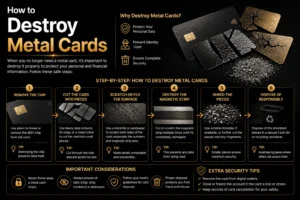
How to Destroy Metal Cards
You just received a shiny new replacement card in the mail. Or maybe you closed a credit account. Or perhaps your old metal card finally expired after years of faithful service. Now you are staring at a thick, heavy piece of stainless steel or titanium sitting on your kitchen table — and suddenly you realize something important:
You cannot just cut this thing with scissors.
Destroying a metal card is completely different from destroying a standard plastic card. A pair of household scissors that would effortlessly cut through a plastic Visa card will not even scratch the surface of a stainless steel or titanium metal card. And you absolutely cannot toss a metal card in the trash or drop it in your recycling bin without properly destroying the card data first.
This complete guide covers everything you need to know about how to destroy metal cards safely, securely, and responsibly — including every method available, which tools actually work, what to avoid, how to protect your financial data, and what to do with your old metal card if you want to upgrade to a new one.
Quick Answer: How Do You Destroy a Metal Card?
To destroy a metal card safely, you have several options: mail it back to your card issuer using their prepaid return envelope, drop it off at a local bank branch, use heavy-duty tin snips to cut through the chip and magnetic stripe, or use a professional metal card shredder. Never throw a metal card in the trash without destroying the EMV chip and magnetic stripe first, as your card data remains readable and vulnerable to identity theft.
Why Destroying Metal Cards Is Different From Plastic Cards
Before getting into the methods, it is important to understand why metal cards require a completely different disposal approach than the plastic cards most people are used to.
The Material Problem
Standard plastic credit and debit cards are made from PVC — a soft, flexible material that can be cut easily with household scissors, destroyed in a paper shredder, or snapped in half by hand. Most people have destroyed dozens of expired plastic cards this way without giving it a second thought.
Metal cards are built from entirely different materials:
- Stainless Steel — The most common metal card material. Extremely hard and resistant to cutting with standard tools.
- Titanium — Even stronger than steel. Used in high-end bank cards like the Chase Sapphire Reserve and Amex Platinum. Virtually impossible to cut with standard household tools.
- Aluminum — The lightest metal card material. Slightly easier to cut than steel or titanium but still far tougher than plastic.
A standard paper shredder will be destroyed by a metal card — not the other way around. Household scissors will slip right off the card surface. This is not a minor inconvenience — it is a real safety and security challenge that requires the right approach.
The Data Security Problem
Beyond the material challenge, there is a critical security reason why proper destruction matters. Metal cards store sensitive financial data in two places:
The EMV Chip — The small gold or silver square on the front of the card. This microprocessor chip stores encrypted payment data and authentication information. If the chip is not physically destroyed, it could theoretically be read by specialized equipment.
The Magnetic Stripe — The dark stripe on the back of the card. This stores your card number, expiry date, and service code in a format that can be read by any standard magnetic stripe reader. If the stripe is not destroyed, your card data is exposed.
The Card Number — Even the embossed or printed card number on the front creates an identity theft risk if the card is disposed of without obscuring it.
The Federal Trade Commission (FTC) advises all consumers to destroy payment card data before discarding any financial card to reduce identity theft risk. For metal cards, this means making sure the chip, stripe, and card number are all rendered unreadable before disposal.
Method 1: Mail It Back to Your Card Issuer (Recommended)
The safest, easiest, and most responsible way to destroy a metal card is to return it directly to the bank or financial institution that issued it.
How the Mail-Back Process Works
Most major card issuers that provide metal cards have established return programs specifically because they know their customers cannot simply cut up or shred these cards at home.
When you receive a replacement metal card, your issuer will typically include a prepaid return envelope in the same package. This envelope is specifically designed for you to mail back your old card safely.
If you do not receive a prepaid envelope — or if you are closing an account without receiving a replacement — here is what to do:
- Call the number on the back of your card and tell the representative that you need to return your old metal card
- Request a prepaid return envelope — most major issuers will mail one to you at no charge
- Send secure message through your online banking portal if you prefer not to call
- Check the issuer’s website — many banks have instructions specific to their metal card disposal programs
Issuer-Specific Return Programs
Different banks handle metal card returns in different ways:
American Express — Amex is well known for its metal card return program. They typically include a prepaid return envelope with replacement cards, particularly for the Amex Platinum and other premium metal products.
Chase — Chase Sapphire Reserve cardholders regularly report receiving prepaid envelopes with their replacement cards. Chase bank branch employees can also accept expired metal cards for disposal.
Capital One — Capital One provides prepaid envelopes with replacement cards for their metal card products.
Citi — Contact Citi customer service to request a prepaid return envelope for metal card disposal.
US Bank — US Bank branch locations can accept metal cards for disposal. Call ahead to confirm availability.
Why This Method Is Best
- Complete security — The issuer has industrial equipment to properly destroy the card and all its data
- Zero effort — You simply drop the envelope in the mail
- Environmentally responsible — Card issuers typically have metal recycling programs for returned cards
- No risk of injury — No tools, no cutting, no risk of sharp metal edges
- Free — Prepaid envelopes cost you nothing
Method 2: Drop It Off at a Local Bank Branch
If your card issuer has physical branch locations near you, walking in and handing the card to a bank employee is another excellent option.
How to Do It
- Find your nearest branch — Use the issuer’s website or mobile app to locate a branch near you
- Call ahead — Confirm that the branch accepts metal card returns before making the trip. Not all branches have disposal procedures in place.
- Bring identification — Bring a valid government-issued ID and your account information
- Ask specifically for secure disposal — Tell the employee the card is expired or the account is closed and you need secure disposal. They should be able to handle it on the spot or escalate to someone who can.
This method works particularly well for Chase, US Bank, Bank of America, and other major issuers with extensive branch networks across the United States.
Method 3: Use Tin Snips to Cut It Yourself
If you prefer the DIY approach — or if your issuer does not have a convenient mail-back or branch program — you can destroy your metal card yourself using the right tools.
The most accessible and effective DIY tool for destroying metal cards is a pair of tin snips — also called aviation snips or metal shears.
What Are Tin Snips?
Tin snips are heavy-duty cutting tools designed specifically for cutting sheet metal. They look like a cross between scissors and pliers, with hardened steel blades capable of cutting through the stainless steel and aluminum used in most metal payment cards.
You can find tin snips at:
- Hardware stores (Home Depot, Lowe’s, Ace Hardware)
- Online retailers (Amazon)
- Auto parts stores
- Craft and hobby stores
A basic pair of tin snips costs between $10 and $30 and will handle most standard metal card materials effectively.
Step-by-Step: How to Cut a Metal Card With Tin Snips
Follow these steps carefully to destroy the card completely and safely:
Step 1: Gather your materials
- Tin snips (or aviation snips)
- Work gloves (metal edges are very sharp after cutting)
- Safety glasses (small metal fragments can fly during cutting)
- A hard, stable work surface
Step 2: Destroy the EMV chip first The EMV chip is the most important element to destroy. Position the tin snips directly over the gold or silver chip square and cut directly through it. Make at least two cuts through the chip area — one horizontal and one vertical — to ensure it is completely destroyed.
Step 3: Cut through the magnetic stripe Locate the dark magnetic stripe on the back of the card. Make at least two to three cuts directly through the stripe, cutting across it in different directions to render it completely unreadable.
Step 4: Obscure the card number Use the tin snips to cut through the embossed or printed card number on the front of the card. Alternatively, use a permanent marker to completely obscure the digits before disposal.
Step 5: Cut the card into multiple pieces Make additional cuts to reduce the card into several smaller pieces. The more pieces, the harder it is for anyone to reconstruct the card or read any remaining data.
Step 6: Dispose of pieces separately Place the cut pieces in different trash bags or dispose of them separately. This makes it virtually impossible for anyone to reconstruct the card from discarded pieces.
Important Safety Warnings for DIY Cutting
⚠️ Wear gloves — Cut metal edges are extremely sharp and will cause serious cuts on bare hands
⚠️ Wear safety glasses — Small metal fragments can project at high speed during cutting
⚠️ Do not use household scissors — Attempting to cut a metal card with regular scissors can damage the scissors, cause them to slip, and potentially cause injury
⚠️ Do not try to cut titanium cards with standard tin snips — Ultra-premium titanium cards (like some versions of the Chase Sapphire Reserve) may require heavy-duty aviation snips or professional equipment
Method 4: Use a Heavy-Duty Metal Card Shredder
For those who regularly need to destroy multiple cards — or who want the most thorough destruction possible — a heavy-duty shredder rated for metal cards is an excellent investment.
What to Look For in a Metal Card Shredder
Standard paper shredders absolutely cannot handle metal cards. Attempting to feed a metal card into a paper shredder will damage or destroy the shredder and potentially cause injury.
You need a shredder specifically designed for credit cards and metal materials. Look for:
- Cross-cut or micro-cut capability — Cuts cards into tiny pieces rather than long strips, making data reconstruction impossible
- Metal card rating — The product description should specifically mention credit card or metal card capability
- Heavy-duty motor — Standard shredder motors cannot handle metal materials
Dedicated card shredders capable of handling metal cards are available from office supply companies and online retailers, typically ranging from $50 to $200 for personal or small-business use.
Method 5: Return It to a Metal Recycler
If you want to ensure your old metal card is recycled responsibly rather than going to landfill, a specialist metal recycler is an option — but with an important condition.
You must destroy the EMV chip and magnetic stripe BEFORE taking the card to a recycler. The recycler is handling metal for scrap value — they are not in the business of data security and have no obligation to protect your financial information.
Use tin snips to destroy the chip and stripe first (following the steps above), then take the remaining metal pieces to a local metal recycling facility. Most metal recyclers will accept small quantities of stainless steel and aluminum without issue.
What NOT to Do When Destroying a Metal Card
Just as important as knowing the right methods is knowing what to avoid. These common mistakes can compromise your data security or cause injury.
❌ Do Not Throw It in the Trash Intact
An intact metal card in the trash is a significant identity theft risk. The magnetic stripe remains readable and the card number visible until the card is physically destroyed. Dumpster diving for financial data is a real and ongoing form of identity theft in the United States.
❌ Do Not Put It in Regular Recycling
Standard recycling programs are not equipped to handle metal payment cards. Cards tossed into regular recycling bins often end up in landfill anyway — and your financial data goes with them.
❌ Do Not Use a Standard Paper Shredder
A regular home or office paper shredder will be damaged or destroyed by a metal card. Metal card materials are far harder than any material paper shredders are designed to handle.
❌ Do Not Trust Third-Party Destruction Services
If you encounter a service offering to destroy your metal card for you — be very cautious. The FTC and major consumer finance organizations advise against trusting unknown third parties with your payment cards. What looks like a disposal service could be a scam designed to collect card data.
❌ Do Not Try to Bend and Snap It
Some people attempt to bend a metal card back and forth until it snaps. While this might eventually work on thin aluminum cards, it is dangerous (sharp metal edges), time-consuming, and does not guarantee destruction of the chip or magnetic stripe.
❌ Do Not Use Fire or Heat
Attempting to melt or burn a metal card creates toxic fumes from the card’s various materials and coatings, creates a fire hazard, and is unlikely to fully destroy the card data anyway. Do not attempt this method.
How to Protect Your Data Before Disposal
Regardless of which destruction method you choose, take these data protection steps before your old metal card leaves your hands:
1. Confirm the card is no longer active — Call your card issuer or log in to your account to confirm the card has been deactivated before disposal.
2. Update automatic payments — Make sure any recurring subscriptions, utility payments, or automatic charges linked to the old card have been updated to your new card or payment method.
3. Remove the card from digital wallets — Delete the old card from Apple Pay, Google Pay, Samsung Pay, and any other digital wallet where it was stored.
4. Remove from online shopping accounts — Delete the card from Amazon, PayPal, Shopify stores, and any other online retailer where the card details are saved.
5. Check your statements — Review your final statements on the account to confirm no unexpected charges appear after account closure.
Can a Metal Card Be Reused or Repurposed?
Before destroying an old metal card, it is worth considering whether it has an alternative use. Here are some legitimate and creative options:
Upgrade It Instead of Destroying It
If your metal card is expired or you simply want a new design — but the underlying bank account is still active — you do not necessarily need to destroy anything.
Royal Metal Card offers custom metal card conversion services where your existing card’s EMV chip can be transferred into a brand new custom-designed metal card body. Instead of destroying your old card, you can upgrade it to a completely fresh metal card with a design that reflects your personality, brand, or interests.
This is an increasingly popular option for people who:
- Want a completely new design without changing their bank account
- Have a card whose design has become worn or outdated
- Want to upgrade from a standard bank design to something fully personalized
If upgrading is something you are considering, the chip from your current card can be transferred during the conversion process. Just ensure your old card shell is properly destroyed after the chip is removed.
Creative Repurposing
Expired metal cards with non-functional data have been used creatively for:
- Guitar picks — The weight and material of stainless steel cards makes them surprisingly effective guitar picks for certain playing styles
- Craft projects — Metal cards can be used as bases for small metalwork or jewelry projects
- Scrapers — An expired card with no readable data can serve as a scraper for small tasks
Important: Only repurpose a card after confirming the account is fully closed and the card is completely deactivated. Never repurpose a card that still has an active account attached to it.
Metal Card Disposal: Environmental Considerations
Metal cards have a significantly better environmental profile than plastic cards in most respects — but their disposal still requires care.
Why Metal Cards Are More Eco-Friendly Than Plastic
- Longer lifespan — A stainless steel metal card lasts 5 to 10 years versus 1 to 3 years for plastic, meaning far fewer cards are produced and discarded over time
- Recyclable materials — Stainless steel, aluminum, and titanium are all fully recyclable materials that can be melted down and reused indefinitely
- No microplastic pollution — Unlike plastic cards that degrade into microplastics in landfill environments, metal cards do not contribute to microplastic contamination
How to Dispose of Metal Cards Sustainably
The most sustainable disposal option is returning the card to your issuer, who typically has recycling programs in place. The second most sustainable option is taking the (data-destroyed) pieces to a metal recycler after cutting with tin snips.
Avoid landfill disposal whenever possible — not because metal cards create the same pollution risks as plastic, but because valuable recyclable metal should be recovered rather than buried.
Special Situations: When You Need to Destroy a Metal Card Immediately
Sometimes card destruction cannot wait for a prepaid envelope or a trip to a bank branch. Here are the most common urgent situations and how to handle them:
Your Card Was Compromised or Stolen and Then Recovered
If your metal card was stolen, used fraudulently, and then recovered by law enforcement or returned to you — do not attempt to use it again. Contact your card issuer immediately to confirm the account status, then destroy the card using tin snips following the steps above.
Your Account Was Closed Unexpectedly
If your card issuer closed your account without sending a replacement, contact them immediately to request a prepaid return envelope. In the meantime, keep the card in a secure location — do not leave it anywhere accessible to others.
You Found an Old Metal Card With an Unknown Status
If you find an old metal card and are not sure whether the account is still active, contact the card issuer before taking any action. Do not attempt to use the card — contact the issuer to determine the account status and follow their disposal instructions.
Frequently Asked Questions (FAQ)
How do you destroy a metal credit card? The safest methods are mailing it back to your card issuer using their prepaid return envelope, dropping it at a local bank branch, or cutting it yourself with tin snips — making sure to cut through the EMV chip and magnetic stripe first.
Can you cut a metal card with scissors? No. Standard household scissors cannot cut through stainless steel or titanium metal cards. You need tin snips (metal shears) for DIY destruction. Using regular scissors on a metal card risks damaging the scissors and potentially causing injury.
Can you put a metal card in a shredder? Not in a standard paper shredder — it will damage or destroy the machine. You need a heavy-duty shredder specifically rated for credit cards and metal materials.
Do banks accept old metal cards? Yes. Most major card issuers with metal card products — including Chase, American Express, Capital One, and Citi — have return programs. Many provide prepaid envelopes with replacement cards, and some bank branch locations accept cards for in-person disposal.
Is it safe to throw a metal card in the trash? No. An intact metal card in the trash is an identity theft risk because the magnetic stripe and card number remain readable. Always destroy the chip and stripe before disposal.
Can I recycle a metal card? After destroying the EMV chip and magnetic stripe with tin snips, the remaining metal pieces can be taken to a metal recycler. Do not put an intact card in regular recycling programs — they are not equipped to handle payment cards.
What tools do I need to cut a metal card? Tin snips (aviation snips or metal shears) are the most accessible and effective tool for cutting metal cards at home. Always wear gloves and safety glasses when cutting metal.
Does a metal card get deactivated when I get a new one? In most cases yes — when your bank sends a replacement card, the old card is automatically deactivated on the new card’s activation date. However, always confirm with your issuer rather than assuming deactivation has occurred.
Can I reuse my metal card chip in a new card? Yes — through a professional metal card conversion service like Royal Metal Card, your existing EMV chip can be transferred into a brand new custom-designed metal card body. This is a popular alternative to destruction for people who want to upgrade their card’s design.
How long does it take to destroy a metal card with tin snips? With proper tin snips and following safety precautions, cutting a metal card into multiple pieces takes approximately 2 to 5 minutes. The most important cuts — through the chip and magnetic stripe — take less than a minute.
Is it legal to destroy a metal card? Yes. Once a card account is closed or the card is expired and replaced, you are legally permitted to destroy the card. In fact, financial security guidelines recommend doing so promptly to protect your personal data.
What should I do before destroying my metal card? Before destroying your old metal card, confirm the account is deactivated, update any automatic payments to a new card, remove it from all digital wallets (Apple Pay, Google Pay), delete it from online shopping accounts (Amazon, PayPal), and review your final statements for any unexpected charges.
The Bottom Line: How to Destroy Metal Cards the Right Way
Destroying a metal card requires more thought and the right tools compared to a standard plastic card — but it is not complicated once you know what to do.
Here is a quick summary of your best options:
| Method | Best For | Cost | Security Level |
|---|---|---|---|
| Mail back to issuer | Everyone — safest and easiest | Free | ⭐⭐⭐⭐⭐ Highest |
| Drop off at bank branch | Those near a branch location | Free | ⭐⭐⭐⭐⭐ Highest |
| Tin snips DIY | Those who prefer home disposal | $10–$30 tool | ⭐⭐⭐⭐ High |
| Metal card shredder | Frequent card disposal needs | $50–$200 | ⭐⭐⭐⭐⭐ Highest |
| Metal recycler | Eco-conscious disposal | Free | ⭐⭐⭐ Medium (chip must be destroyed first) |
Whatever method you choose, the non-negotiables are always the same: destroy the EMV chip, destroy the magnetic stripe, and never dispose of an intact metal card in regular trash or recycling.
Your financial security is worth the extra few minutes that proper metal card disposal requires.
Thinking About Upgrading Instead of Destroying?
If your old metal card is expired or you simply want a fresh new design — but you love your existing bank account and do not want to change anything — there is a better option than destruction.
Royal Metal Card specializes in custom metal card conversion, transferring your existing chip into a brand new premium metal card with a design that is completely personalized to you. From minimalist luxury designs to anime artwork, business branding to automotive themes — your new card can look exactly the way you want it to look.
Instead of destroying your old card, upgrade it. Keep your same bank account, same card number, same rewards — and start carrying a metal card that truly represents who you are.