
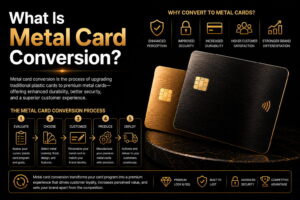
What Is Metal Card Conversion?
Metal card conversion is the process of transforming an existing plastic debit or credit card into a metal card by transferring the original EMV chip into a new stainless steel or aluminum body. Your account, card number, and bank relationship stay exactly the same — only the physical material changes.
This is different from applying for a premium metal card through a bank. Conversion works with a card you already have and use every day. Instead of switching accounts or going through a new application, you keep everything about your existing card except the material it’s made from.
For anyone hearing this term for the first time, the easiest way to understand it is this: your bank issues the card. A conversion service changes what it’s made of.
How Metal Card Conversion Actually Works
Conversion isn’t just gluing metal onto a plastic card. It’s a precise process built around one sensitive step: safely relocating a working chip into a new material.
Step 1: Card Eligibility Check
Not every card qualifies. Chip placement, card thickness, and overall design layout all affect whether a conversion can be done safely. This is usually the first thing a provider checks before moving forward. A closer look at this stage is covered in our Card Eligibility Guide.
Step 2: Design and Engraving Planning
Before any physical work begins, the customer’s design choices are finalized — name, logo, finish, and layout. This step matters because engraving decisions affect how the final card looks and reads.
Step 3: Metal Card Body Preparation
A metal blank (stainless steel or aluminum) is cut to standard card dimensions and given its surface finish — brushed, matte, mirror, or anodized color. Material and finish options are broken down further in our Metal Card Materials And Finishes guide.
Step 4: Chip Extraction
The original EMV chip is carefully removed from the plastic card. This is the most delicate part of the process, since any damage here would affect the card’s usability.
Step 5: Chip Embedding
The extracted chip is securely installed into the new metal card body, positioned correctly for terminal compatibility.
Step 6: Laser Engraving
Name, card details, and any custom design elements are engraved directly into the metal surface using precision laser equipment.
Step 7: Functional Testing
Before shipping, the card is tested to confirm the chip reads properly and processes transactions the same way it did in plastic form.
Step 8: Quality Inspection
A final check confirms engraving accuracy, edge finishing, and overall build quality.
What Changes vs. What Stays the Same
This is the part most people want a straight answer on, so here it is in table form.
| Stays the Same | Changes |
|---|---|
| Account number | Card material |
| Bank relationship | Weight |
| PIN and security settings | Personalization method (engraved vs. printed) |
| Chip encryption and technology | Surface finish |
| Card expiration date | Overall appearance |
If you’re picturing conversion as “getting a new card,” that’s not quite accurate. It’s closer to giving your current card a new body while its internal identity stays untouched.
What Metal Card Conversion Does Not Include
Being upfront here matters, because a few assumptions come up often.
- It doesn’t add contactless (tap-to-pay) by default. NFC requires a separate antenna that must be specifically built in — a standard conversion doesn’t include this automatically.
- It doesn’t make your card more secure. Security comes from the chip and encryption standard, not the material. Metal adds durability, not fraud protection.
- It doesn’t create a new bank account. Your existing account and card number carry over exactly as they were.
- It doesn’t work on every card. Compatibility depends on chip type and card design.
For a full breakdown of these limitations, see our Metal Card Vs Bank-Issued Metal Card comparison.
Why People Choose Conversion Instead of Applying for a New Card
Bank-issued premium metal cards usually require a new application, credit check, or eligibility for a specific account tier. Conversion skips all of that.
Common reasons people choose conversion:
- They like their current bank and don’t want to switch
- They want a durable, custom card without applying for a new product
- They want permanent, laser-engraved personalization
- Their existing plastic card is worn, cracked, or fading
This is really where conversion earns its place — it’s the practical, no-new-application path to a metal card. Real-world examples of who chooses this route are covered in our Who Uses Metal Cards article.
How Long Does Metal Card Conversion Take?
Turnaround depends on a few factors:
- Design complexity (simple text vs. detailed logo work)
- Material and finish selected
- Current order volume with the provider
- Whether any design revisions are needed before production
Most providers outline expected timelines at the point of order confirmation, since it varies more by design complexity than by the conversion process itself.
Is Metal Card Conversion Safe?
Yes, when handled by an experienced provider. The main risk in the entire process is chip damage during extraction or embedding, which is why reputable providers test the card’s function both before finalizing design work and after the chip is transferred.
What a trustworthy provider should confirm:
- The chip is tested for function before conversion begins
- The chip is not reprogrammed or replaced — only relocated
- The card is tested again after the transfer is complete
- No new account or card number is created during the process
Royal Metal Card follows this exact structure — assess, transfer, test, verify — because the chip transfer is the one step in the entire process where precision actually matters.
Metal Card Conversion vs. Buying a Premium Bank Card
| Factor | Conversion | Bank-Issued Metal Card |
|---|---|---|
| New application required | No | Yes |
| Keeps existing account | Yes | No — new account |
| Credit check involved | No | Often yes |
| Custom engraving | Yes | Limited or none |
| Turnaround | Typically faster | Often weeks to months |
| Contactless included | Only if specifically added | Usually yes |
Frequently Asked Questions
Does metal card conversion change my card number?
No. The original chip, which stores your account and card number, is transferred as-is into the new metal card. Nothing about your account changes.
Can any plastic card be converted to metal?
Not always. Eligibility depends on chip type, card thickness, and design layout. A quick compatibility check before ordering confirms this.
Will my converted card still work at ATMs and payment terminals?
Yes. Since the same chip is used, the card functions identically at ATMs and terminals as it did before conversion.
Does conversion add tap-to-pay to my card?
Not automatically. Contactless payment requires a separate NFC antenna that must be specifically built in — this isn’t a default part of standard conversion.
Is metal card conversion risky for my chip or account?
When done by an experienced provider, no. The chip is carefully extracted, tested, transferred, and tested again — your account and card number are never altered in the process.
How is conversion different from applying for a metal card through my bank?
Conversion upgrades a card you already have without a new application or credit check. Bank-issued metal cards typically require applying for a new account or card product entirely.
Conclusion
Metal card conversion is a straightforward concept once it’s broken down: your existing chip is carefully moved into a new, durable metal body, while your account, card number, and bank relationship stay completely unchanged. It’s not a new card — it’s your current card, rebuilt in a material that lasts longer and looks distinctly different.
Understanding exactly what changes and what doesn’t is the best way to decide if conversion is the right fit, especially compared to applying for a premium bank card from scratch.